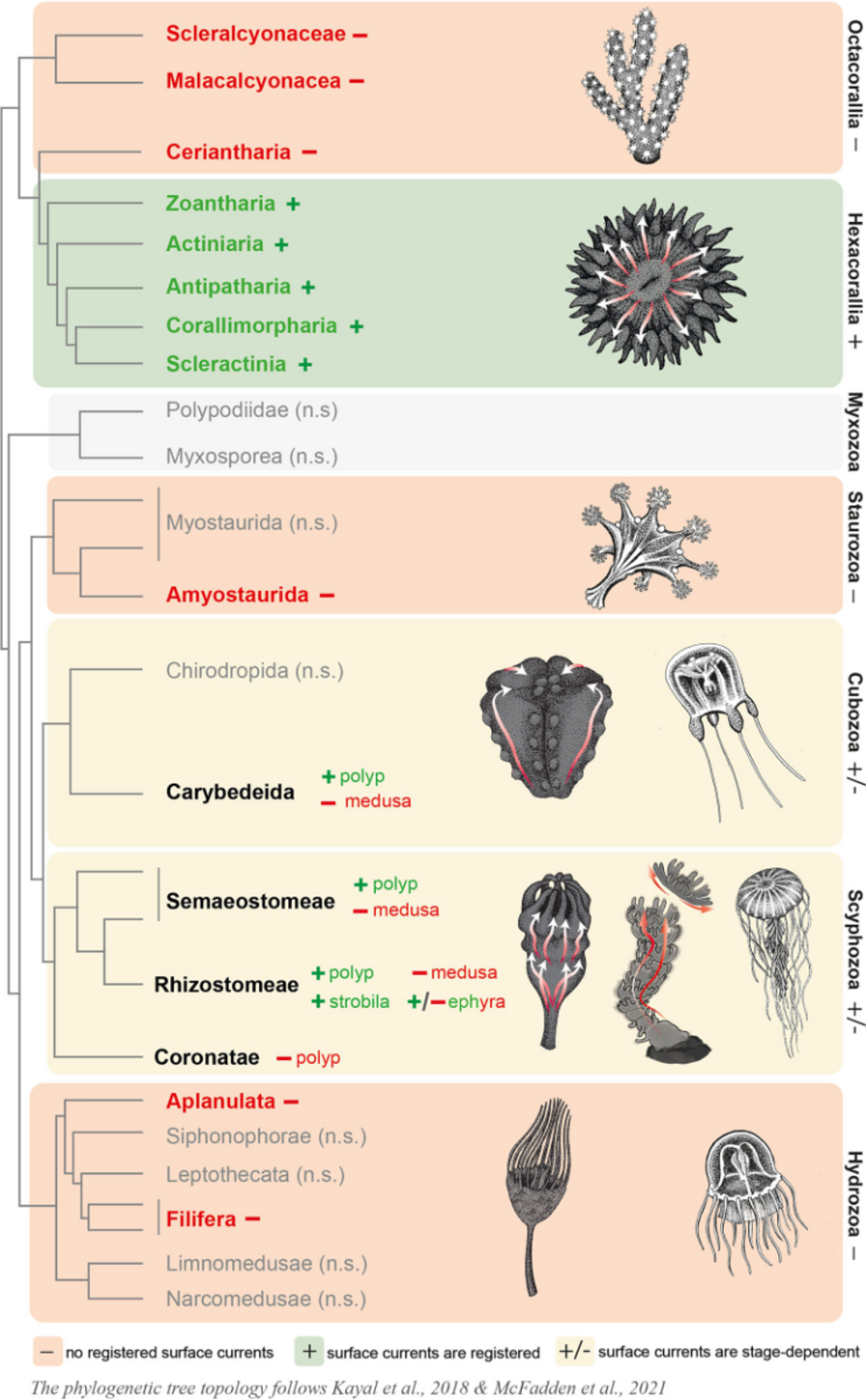
In sessile animals, body surface-associated water currents are essential for integrating feeding, cleaning, and boosting metabolic exchange across colonies or communities of solitary individuals. The evolutionary origins of surface currents and their distribution among cnidarians remain poorly understood. Here, we investigated directional surface currents by tracking moving fluorescent beads on live specimens. We show that surface-associated flows are widespread among cnidarians, including anthozoans, scyphozoans, and cubozoans, but vary in complexity. The structural organization of these currents, as well as flow regimes, correlates with animal size, coloniality, and feeding strategy, highlighting their evolutionary significance across diverse lifestyles and morphologies. Notably, we observed a consistent absence of cilia-driven surface flows in octocorals, hydrozoans, and staurozoans. Moreover, surface flow was also stage-dependent, being absent in medusae but present in polyps of the same species. This suggests that the muscle-mediated motility of a cnidarian medusae might reduce the necessity for surface-mediated hydrodynamic control in cnidarians. Overall, the patchy distribution of cilia-driven surface currents implies repeated evolutionary gains and losses under selective pressure in multiple systematic groups.
Further reading: https://doi.org/10.1038/s42003-026-09827-0